


If you’re searching for Bill Gothard net worth, you’ve probably seen different numbers with little explanation. That’s confusing. The most reliable estimate puts his net worth between $2 million and $5 million as of 2026, based on his long career in seminars and his role in the Institute in Basic Life Principles. The real question isn’t just the number. It’s where that money came from and what changed over time.
I ran into the same issue while reviewing multiple sources. Some gave a number and moved on, while others skipped the financial side completely. This article focuses on what actually matters: how Bill Gothard earned his money, how his income worked through structured programs, and what likely happened after 2014. By the end, the estimate will make a lot more sense.
Bill Gothard Net Worth
Bill Gothard’s net worth is estimated between $2 million and $5 million as of 2026.
- Main income: Seminars and speaking events
- Other income: Books and teaching materials
- Current status: Wealth based on past earnings
Bill Gothard’s net worth is estimated between $2 million and $5 million as of 2026.
This estimate is based on his long career in seminars, teaching programs, and his leadership role in the Institute in Basic Life Principles.
Most estimates land here because his income didn’t come from a typical salary. Instead, it came through years of seminars, teaching programs, and influence built over decades, which makes the structure behind the money more important than the number itself.
Who Is Bill Gothard?
Bill Gothard is a Christian speaker and teacher who gained influence in the United States during the 1970s and beyond. His work focused on personal development, family structure, and religious teaching.
Early Life and Background
He was born in 1934. His early path was shaped by religious education and a strong interest in teaching biblical principles.
Simple start.
Career Overview
Gothard became widely known for hosting large seminars across the country. These events attracted thousands of attendees at a time, giving him both influence and a steady income stream over several decades.
That kind of consistency matters.
Career and Role in the Institute in Basic Life Principles

The Institute in Basic Life Principles (IBLP) became the center of his work. It wasn’t a small ministry. It operated as a structured organization with programs, materials, and a wide audience.
Growth of IBLP
IBLP expanded through seminars, training programs, and homeschooling materials tied to the Advanced Training Institute (ATI), which reached families across the United States and beyond over several decades.
The Advanced Training Institute (ATI) also played a role in expanding reach. Families who participated often used structured materials over long periods, which helped create consistent demand for educational content tied to the broader system.
Influence and Reach
Gothard built more than a following. He built a system where people attended events, bought materials, and stayed connected through structured programs.
That kind of ecosystem creates long-term revenue.
Timeline of Bill Gothard’s Earnings
- 1970s – Early 2000s: Peak years with large seminars and strong income growth
- 2000s – 2014: Continued influence through programs and materials
- Post-2014: Reduced public role and decline in active income sources
His financial story becomes clearer when you look at timing.
His peak earning years likely ran from the late 1970s through the early 2000s, when large in-person seminars regularly filled venues with thousands of attendees across multiple events each year, creating a steady and scalable income stream over time.
That period shaped most of his long-term earnings.
After 2014, things changed.
His resignation reduced his public role and likely cut off the main channels that once generated income, shifting his financial position from active earning to maintaining existing wealth.
How Did Bill Gothard Make Money?
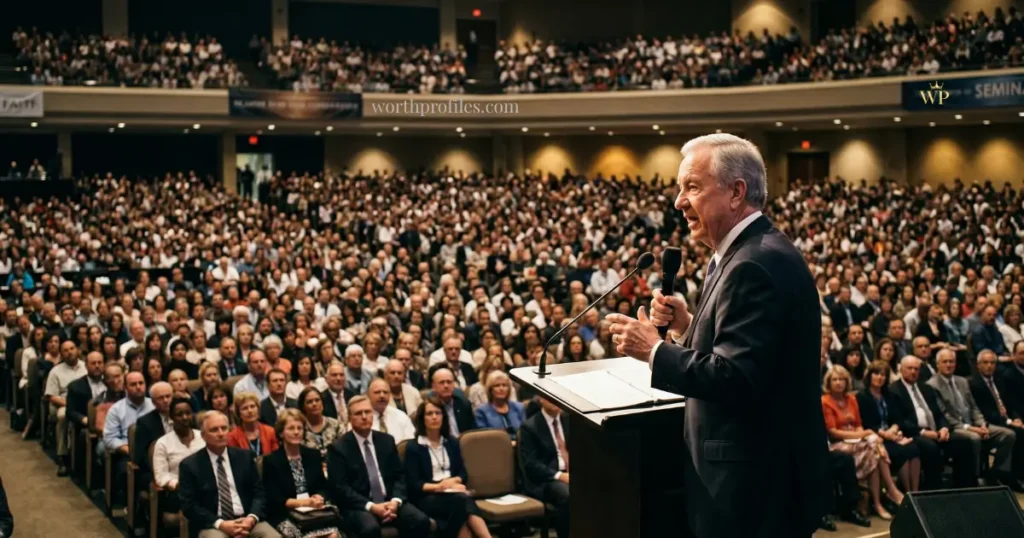
Bill Gothard made money mainly through seminars, teaching materials, and ministry-related programs.
His income didn’t come from one place. If you want to understand this better, it helps to look at how net worth is calculated and how different income streams combine over time. The pattern becomes clearer when you break it down.
Seminar and Speaking Income
Seminars were a major driver.
Many events drew thousands of attendees in large venues across the country, which means even moderate ticket prices could generate strong revenue when repeated over many years and locations.
Repetition is what made it powerful.
For example, if a seminar hosted a few thousand attendees paying a moderate fee, even a single event could generate substantial revenue, and repeating that model across different cities over many years creates a predictable income pattern.
Book Sales and Royalties

Gothard also produced books and teaching materials used within his programs. These weren’t mass-market bestsellers, but they created steady income over time.
Quiet income.
Still important.
Ministry Funding and Donations
Ministry-related funding supported the broader organization.
Here’s the thing: this doesn’t always translate directly into personal income, but it supports the system that allows influence, travel, and continued program development.
Income Sources Breakdown

| Income Source | Description | Importance |
|---|---|---|
| Seminars | Large events with paid attendance | High |
| Books & Materials | Educational and religious content | Medium |
| Ministry Programs | Structured teaching systems | Variable |
Bill Gothard’s income came from three main sources: seminars, educational materials, and ministry funding.
If you simplify it, his income likely came from:
- Paid seminars
- Educational materials
- Ministry-related funding
That’s the surface view. To understand this better, it helps to see how ministries generate income through events, materials, and structured programs. The structure behind it explains the result.
Relative Importance of Income Streams
Not all sources carried equal weight.
Seminars were likely the main driver, especially because recurring events across multiple cities can generate consistent income over time, while books and materials added steady support, and ministry funding helped sustain the overall structure rather than acting as direct personal income in a simple way.
Financial Structure of IBLP
IBLP is a nonprofit organization, which means its revenue does not directly equal personal income.
Revenue generated through programs and events does not automatically become personal income, and while leadership roles can include compensation or indirect benefits, much of the funding is typically used for operations, staffing, and program delivery rather than direct wealth accumulation.
That distinction matters more than it first appears.
In cases like this, it helps to separate organizational revenue from personal earnings. Nonprofit organizations such as IBLP can generate significant income through programs and events, but that does not mean the same amount becomes personal wealth for the individual leading it.
Lifestyle and Assets
Public information about Bill Gothard’s personal assets is limited.
There are no widely reported luxury homes, private jets, or high-profile purchases tied to his name. There are also no clearly documented real estate holdings or high-value investments publicly associated with him, which makes his financial profile less visible than many other public figures.
That low visibility makes analysis harder.
Controversies and Legal Issues
In 2014, Bill Gothard stepped down from IBLP after multiple allegations were brought forward. This marked a major turning point in his public role.
It also changed how his income worked.
Allegations and Resignation
The allegations led to internal investigations and his eventual resignation, which removed him from the leadership position that had been central to his visibility and influence for decades.
Public Response
Reactions were mixed.
Some followers remained supportive, while others distanced themselves, and that kind of shift typically affects long-term earning potential tied to public trust.
Financial Impact of Controversies

This is where the net worth story changes.
Before 2014, Gothard had active income streams tied to seminars and leadership roles. After stepping down, those direct channels likely slowed or stopped, which means his financial position became more dependent on what had already been earned rather than new income generation.
That shift is key to understanding his current net worth.
Is Bill Gothard Still Wealthy Today?

Yes, Bill Gothard is still considered wealthy based on past earnings, but he is not known to have strong active income sources today.
His estimated net worth remains between $2 million and $5 million, which suggests that past earnings continue to support his current financial position even if new income sources are limited.
It’s more about retention than growth now.
Wealth vs Active Income
There’s a difference between earning money and holding wealth.
Even without strong ongoing income, decades of earnings from seminars and programs could sustain his financial position, especially if those funds were managed conservatively over time.
In practical terms, someone who earned consistently for decades may still hold significant assets even if they are no longer generating new income at the same level.
Is Bill Gothard’s Net Worth Accurate?
Net worth figures are estimates based on publicly available data. Exact financial details are not disclosed, so values may vary.
Bill Gothard’s net worth is an estimate, not an exact figure.
It is based on publicly available information and reasonable assumptions about his past income.
Net worth estimates are usually calculated by combining known income sources, public records, and reasonable assumptions about long-term earnings.
Different sources may use different assumptions when estimating wealth, which is why figures can vary even when they are based on similar underlying information.
Net Worth in Context
| Category | Typical Net Worth |
|---|---|
| High-profile televangelists | $10 million+ |
| Ministry leaders | $1M – $5M |
Compared to high-profile televangelists who often have media networks and large business operations, a $2 million to $5 million range is relatively modest despite Gothard’s long influence, especially when compared to figures like Jim Bob Duggar’s estimated net worth and similar public personalities.
One reason for this could be the structure of nonprofit organizations, where revenue is often reinvested into programs rather than accumulated as personal wealth.
Financial estimates for religious figures often differ from those of business leaders because their income is tied more closely to influence and organizational structure rather than direct ownership of assets or companies.
FAQs
What is Bill Gothard’s net worth in 2026?
Bill Gothard’s net worth is estimated between $2 million and $5 million.
How did Bill Gothard make his money?
Bill Gothard made money through seminars, teaching materials, and ministry programs.
Is Bill Gothard still earning money today?
There is no clear evidence of active income at the same scale as before 2014.
Did controversies affect his wealth?
Yes. His resignation likely reduced his ability to generate new income through his previous platforms.
What was Bill Gothard’s main source of wealth?
His primary source of wealth was large-scale seminars, which generated consistent income over many years.
Conclusion
After looking at the details, the $2 million to $5 million estimate for Bill Gothard’s net worth feels reasonable given his decades of influence, seminar-driven income, and structured ministry work. The shift after 2014 also helps explain why that number has remained stable rather than growing in the same way it might have earlier in his career. If you’re trying to understand figures like this, focus on how the money was earned and sustained over time, because that is what makes the estimate meaningful.